

GOOD MORNING FROM LONDON
————————————-
EXTRACT #1
CHINA’S NEWEST AIRCRAFT CARRIER LAUNCHED
THE FINANCIAL TIMES.
“China’s third aircraft carrier has officially entered service, boosting the country’s military power far beyond its shores. Chinese leader Xi Jinping oversaw the commissioning of the Fujian — the first carrier both developed and built domestically — in a ceremony on the southern island of Hainan on Wednesday, state media announced on Friday.
The move comes as the People’s Liberation Army is rapidly catching up with the US military, which has dominated the Indo-Pacific since the second world war.
A fourth carrier is under construction, and Chinese military texts — such as textbooks and academic papers by PLA-linked figures — suggest Beijing is planning several more.
The Chinese Communist party is pursuing a cutting-edge military that can rival US forces to gain dominance in its “near abroad”, where it has territorial disputes with several neighbours”, but also to project power further afield and secure its increasingly global economic interests.”
GRAHAM PERRY COMMENTS;-
There are two conflicting ways of viewing China’s construction of aircraft carriers;-
EITHER, China is pursuing the same policy as the Great Powers of the 19th Century – gunboat diplomacy based on acquiring the territories of Third World countries. The argument goes “China is imperialist. China is acquisitive. China intends to take control of Taiwan and nearby vulnerable countries, seize their natural resources, impose compliant governments and dominate the high seas in pursuit of its world wide policy of control, domination and exploitation. Looking ahead China intends to become the Sole Superpower of the future eclipsing and eventually dominating the U.S.”
OR, since the Korean War of 1950-51 China has always anticipated that the U.S. has intended to attack China whose entire military operations are based on securing its borders, frontiers and seaways. Bear in mind the comparative figures for overseas military bases. The U.S. has 800+ bases around the world with 400+ in the Far East. China has just one base in Djibouti which exists to serve China’s large maritime fleet. Unlike the U.S. China has no military – not one soldier, sailor or pilot – outside of China.
The question therefore arises – Who Is Threatening Whom?
A recent article in Australia’s Pearls and Irritations asserts that China is neither expansionist nor aggressive. It has had border disputes with neighbouring countries, which were territorial disputes arising from the historical consequences of colonialism, not campaigns to occupy or colonise other sovereign states.
But U.S. Defence Secretary Pete Hegseth, has recently said that China is the U.S.’s “peer competitor… with the capability and intent to threaten our homeland and core national interests in the Indo-Pacific”. By the same token China has big concerns about the fundamental rupture to their flow of two-way trade (imports and exports) if the U.S. was to use its enormous military power in the Far East to blockade China’s main East Coast ports. China knows its strengths but it also knows its vulnerabilities and its defence expenditure is based on its protection and not on its expansion. One final observation that makes the point. China has lent trillions of U.S. dollars to 150 countries through its Belt and Road Initiative without one dollar being spent on sending one soldier, sailor or pilot to any one of the recipient countries.
====================
EXTRACTS #2
THE FINANCIAL TIMES
STARBUCKS
“China’s coffee war has become the hottest showdown in global retail. What started out as an unlikely contest between Starbucks and a handful of local start-ups has now turned into a bitter feud.
Facing homegrown rivals and eroding brand power, Starbucks has agreed to sell a majority stake in its China business to Boyu Capital, creating a $4bn joint venture. That marks a shift from dominance to survival.
Local rivals such as Luckin and Cotti are expanding rapidly in China, slashing prices and catering to local tastes. Meanwhile, chains known for other drinks are moving into the same space and fighting for the same customers. Tea and bubble tea giants including Mixue and Guming are now a significant presence both in physical stores and delivery apps.
That means Starbucks no longer competes only with local coffee peers. Of those peers, Luckin Coffee alone has more than 26,000 outlets across China, more than three times Starbucks’ reach.”
GRAHAM PERRY COMMENTS;-
The foreign media has in so many respects underestimated China. Not only foreign media but foreign businesses as well. It’s a Cultural Thing. It is an Ego Thing. Thomas L Friedman of the New York Times realises this. He gets it – he sees the dynamic of China and he is no Marxist. He is an American patriot through and through but the Western media generally has missed the big development.
China does not mind. It is pleased to be overlooked and under-estimated and Rare Earths is the first big example. Just one fact – China’s current number of Science PhD students far outweighs the U.S. equivalent number. Reflect for a moment on what that means for a widening technological gap in the run-up to the biggest date in China’s calendar – 1 October 2049.
Back to Starbucks – two things have happened. First, China’s Tea companies have completed their apprenticeship and are ready for the big stage. Second, Starbucks should have protected itself from diminishing market share by forming a Joint Venture with Boyu in 2015 not 2025. Boyu has a strong record of using its political and retail networks to turn around foreign companies that can no longer rely on brand prestige alone in sectors in which Chinese rivals compete on price and growing customer satisfaction.
—————————-
EXTRACT #3
METALS WEEKLY NEWSLETTER
POST SEOUL, THE U.S. GETS BUSY ON RARE EARTHS
“President Donald Trump hosted leaders of five Central Asian countries at the White House recently as he intensifies his hunt for rare earth metals needed for high-tech devices, including smartphones, electric vehicles and fighter jets.
Trump and the officials from Kazakhstan, Kyrgyzstan, Tajikistan, Turkmenistan and Uzbekistan held bilateral meetings in the Oval Office before having a working dinner. “These nations were once home to the ancient Silk Road connecting East and West,” Trump said, while noting that “sadly, previous American presidents neglected this region completely.”
GRAHAM PERRY COMMENTS;-
Too little too late?
Is the U.S. closing the stable door after the horse has bolted?
The U.S. has to act. It has to hope that it can make up the big difference that has opened up in Rare Earths.
China has a lot. The U.S. has a little.
China is neither smug nor complacent. It is ahead and it knows it has to stay ahead and here are China’s Three Priorities;-
- it must strengthen relationships with overseas Rare Earth suppliers;
- it must deepen and widen its search for increased domestic Rare Earths;
- it must refine and improve its extraction and processing skills.
Significantly, the Chinese Commerce Ministry said that rare-earth restrictions that had been announced on Oct. 9 would be postponed just for one year. Remember what those paused restrictions cover;-
- An expansion of the types of rare-earth elements for which export licenses are required and
- Tighter controls on the export of equipment used for exploration and refining, as well as the technologies necessary for manufacturing rare-earth magnets.
- A requirement that foreign companies making products containing Chinese rare earths have to obtain permission from Beijing when exporting to other countries and regions.
Interestingly a fact sheet recently released by the White House does not include a time frame, saying “China will suspend the global implementation of the expansive new export controls on rare earths and related measures that it announced on October 9, 2025.”
The 12 month period is a warning to the U.S. – Behave yourself or the Rare Earths restrictions will be re-imposed. There could be no greater evidence of the power swing from West to East.
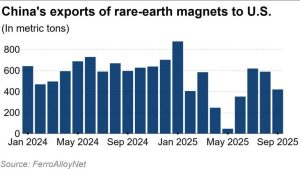
China accounts for 70% of rare-earth production and over 80% of rare-earth magnet manufacturing. It has been leveraging this bargaining chip in negotiations with Washington.
Exports of rare-earth magnets to the U.S. in April were down 59% year-on-year, according to an analysis of trade statistics by Chinese research company FerroAlloyNet. Amid escalating trade friction and the imposition of tariffs over 100% by both sides, exports were drastically cut. They halted almost completely in May, falling 93% on the year.
Global supply chains were thrown into disarray, with Ford Motor temporarily suspending operations at some U.S. plants. In September, the most recent data available, exports of rare-earth magnets to the U.S. were still down 30% year-on-year.
China will continue to be the dominant world leader in Rare Earths extraction and processing.
—————————-
EXTRACT 4
CHINA’S NEW FIVE YEAR PLAN
PEARLS AND IRRITATIONS OF AUSTRALIA
“In this five-year plan, China seeks to complete its transition toward an advanced, innovation-led economy, a core component in that being the movement from “made in China” to being “designed in China”.
In such previous planning, new and emerging technologies have been identified and fostered. Examples are found in China’s development of green energy (solar and wind energies), progress in EVs, digital infrastructure and robotics, along with the mining and processing of the rare earths necessary for these. Careful long-term planning has led to China’s dominance in all these areas, while also making further advances into quantum computing, 6G, semiconductors, green hydrogen, bio-technology and fusion energy.
GRAHAM PERRY COMMENTS;-
Bearing in mind the US’s declared intention to restrain China’s advance in semiconductors, advanced chips and solar energy it is no surprise that the new Five-Year Plan emphasises China’s need to be self-reliant in these same sectors (Semiconductors, advanced chips and solar energy).
Core to the latest plan is linking of scientific research to industrial development. Long gone are the days of China’s growth being powered by it being the low-cost manufacturing hub of the world.
The Plan also emphasises the need to increase internal consumer demand as part of the existing “dual circulation” framework. Boosting internal consumption is underlined for priority attention with the focus on raising household incomes and employment opportunities.
———————————-
PART 21; CHINA AND JACK PERRY
The Emergence of Dr Ji Chaoding
Part 20 concluded as follows
“In the summer of 1927 Dr Ji met Harriet Levine an American from New York whom he had met on a ship travelling to Europe. They married and had two sons: Emile (born 1936) became a mathematician, and Carl (born 1940) became a neuro-physiologist. Harriet went to China for the first time in 1947. She and Ji separated in Shanghai, and she returned to New York.”
There are two important aspects to the work of Dr Ji – both stemming from his concealed membership of the Communist Party of China which he had joined during his student days at Beijing University. At that time the newly formed CPC was in a United Front alliance with the Nationalist Party of Sun Yatsen and Dr Ji was in the U.S. He was popular among Chinese Americans and developed a national reputation as a public speaker able to arouse support for China with his anti-imperialist speeches.
In the winter of 1926 Dr Ji – he became a PhD during his later studies at Chicago University – was instructed to visit Europe to attend a League Against Imperialism Conference in Brussels organised by Willi Munzenberg, a member of the Comintern. Ji then went to Moscow following the outbreak of Civil War between the KMT now led by Chiang Kaishek (who had succeeded Sun Yatsen who died in 1926) and the CPC – not yet led by Mao Tstung though he remained among its leading personnel.
In Moscow Ji studied at the Sun Yatsen University in Moscow which had been founded to educate Chinese students in revolution. Ji attended the 6th Congress of the Communist International as one of the Secretaries to China’s delegate, Deng Zhongxia who subsequently advised Ji to return to the United States.
In 1929 Ji had travelled to Frankfurt and met the economic historian, Karl Wittfogel, then a member of the German Communist Party who combined geography and economics to analyse the development of China’s political system. Wittfogel argued that imperial despotism in China arose from control of waterways which enabled the ruling dynasty to gather grain and tax revenue. Ji then returned to the U.S. to attend graduate school in economics at Columbia University during which time he penned articles for the U.S. Daily Worker under the name of Richard Doonping.
Ji’s wife, Harriet, was a cousin of Philip Jaffe, an American Communist who together with Ji formed The American Friends of the Chinese People which supported the role of the CPC in the ongoing Civil War with the KMT. During this time Ji – a dextrous individual of many talents – appeared on Broadway in Roar China written by the Soviet playwright, Sergei Tretyakov
Through Philip Jaffe, Ji served on the editorial board of a new journal – Amerasia – and wrote a regular column entitled “Far Eastern Economic Notes” and during this period funded by The Rockefeller Foundation he returned to China to gather material for a study of China’s Wartime Situation.
With penetration of China by Japan continuing apace, Ji’s father worried that the Japanese invader would learn of the father’s student days in Japan moved to Hankow – the temporary capital of China following the fall of Nanjing. But disenchanted with the Chiang government, and with help from Ji, his son, who was on a visit to China, the father travelled a dangerous passage through South China and Vietnam with his family and reached New York.
Ji’s career now entered upon a remarkable phase. An underground member of the CPC he was recruited in 1939 by the Shanghai banker, K.P. Chen who headed the Universal Trading Corporation, (UTC) a quasi-government mechanism for loans from the U.S. Treasury to the Chongqing Government. Ji and Chen were in New York in 1940 when Ji became Secretary-General of the Sino-British Currency Stabilisation Board which succeeded UTC .
Here occurs an interesting encounter. The American representative on the Board was Solomon (Sol) Adler who started life in Bradford in the UK. Sol was from an orthodox Jewish family. His elder brother was a prominent Professor of Tropical Medicine at Tel-Aviv University. Sol himself settled in China in 1960 and was amongst a small group of venerated individuals who were responsible for finalising the English translations of the Collected Works of Mao Tsetung. More on Sol Adler is future chapters – he tells of an interesting exchange with Mao in 1963 which in retrospect is an indication of the approaching Cultural Revolution. We will get to everything in time.
PART 22 – PREMIER ZHOU ENLAI INSTRUCTS DR JI TO FIND NEW FRIENDS OF CHINA.